Pages

Showing posts with label Churches in France. Show all posts

Monday, March 6, 2017

St. Severin church in Paris


Right around the corner from Notre Dame and St. Julien le Pauvre
stands St. Severin church,
actually within view from St. Julien's entry door.
I thought this shot looked perfect for Easter
coming right up. 


While I was there it was dressed up for the Christmas holiday
complete with Nativity scene
(I love the little angel in the alcove overlooking the scene)...


... and surrounded by a paper sea of baby angels 
made by children. 


How much sweeter could it get?


This little angel particularly stood out. 


Such magnificent vaulted Gothic ceilings.

The church of St. Severin sits in the Latin Quarter
not far from the University so is just near streets and streets of 
restaurants and sweet shops and filled with gaggles of young people.


St. Severin was named either after a hermit who lived along the Seine
in the 5th century, replacing the oratory built over his tomb...
or after Saint Severin, a preacher also of the 5th century. 

The first small church over the hermit's tomb
was replaced to accommodate its growing parish
and was rebuilt again in the 14th century.
Damaged by fire during the Hundred Years War,
it was rebuilt again, finished in 1520
but added onto throughout the centuries. 


While there are many, 
one of the unique features of this church
are the fanning columns in the double ambulatory
that appear almost like a forest of trees,
particularly the center one with its beautifully-carved twisted trunk. 


The Black Heart is a remembrance to a mother and daughter,
Catherine de Brinon and Catherine de Canteleu,
whose family contributed to the church since 1491.
They died in 1699. 


The church is also said to house the relics of the patron saint of the Sorbonne University,
St. Ursule (apparently just one of many churches across Europe to house parts of her relics.)
While it is said that the legend of St. Ursule (or Ursula) could fill 100 pages,
there seem to be a thousand versions. 
But the basic idea is that instead or marrying a Pagan prince,
this 3rd century daughter of a Christian king 
(ruler of Cornwall according to Geoffrey of Monmouth)
fled on pilgrimage to Rome instead, her virginal maidens in tow.
Later, enroute to Cologne, they were all captured by Huns and killed. 
It's believed by some that the Church of St. Ursula in Cologne 
is built over the spot where the holy virgins died. 


Now after reading more about it,
 I just want to go back and take more pictures.
So much more to see and learn. 

Next time, we'll have a short tour of the interior
of the lovely and grand Notre Dame
dressed for the holidays. 

Happy March. It's been snowing here.
I hope the Crocosmia spring bulbs I planted a couple of weeks ago
will still come up. 
Spring forward is almost here. 


(Photos copyright: Kirsten Steen)
Info via Wiki


Tuesday, February 7, 2017

Concert at St. Julien le Pauvre


One of the churches I ventured into this visit to Paris
was St. Julien le Pauvre.
I hadn't remembered on my last trip here
that it's a Greek church! 


Some of you know that I collect photos of
the Annunciation.
And I found this little sweet one below
on one of the panels just underneath the large cross in the first photo. 


This church regularly participates in concerts
and we were able to make this piano and accordion concert
on the first day of the new year. 


St. Julien le Pauvre
is one of the oldest churches in Paris,
 built between 1170-1240. 
But before this building,
from about the 6th century on, 
stood a Merovingian hostel for pilgrims.
It is said that it stood on the Roman road to Spain
and thus for medieval pilgrims 
on the road to St. James shrine at Santiago de Compostela
(though it was too small to be listed in the medieval Pilgrim's Guide.)


describes how Bishop Gregory of Tours 
was the first to write about the basilica and hostel
in his History of the Franks.


As he considered St. Julien 
to be one of his patron saints,
he lodged at the Basilica of St. Julien the Martyr
and said a midnight mass there.


Archaeological finds determined that the building originally stood 
in the middle of an ancient cemetery
and unearthed Roman and Merovingian sarcophagi and other artifacts.


One of my favorite things in the church was this angel.


The little church looked even sweeter with this lovely piano in its midst. 


And I positioned myself in the audience
to have a perfect view of the angel. 


When we got home that evening after the concert,
we went online and discovered that the angel is Archangel Gabriel,
the very same angel who appears in the Annunciation
and is often associated with  gifts of knowledge and messages to prophets.


Another of my favorites at St. Julien le Pauvre
 shows Jesus revealing himself to Mary Magdalene. 


Next time I'll share a few photos outside the church. 
It's located across the river from Notre Dame 
and just across from the entrance to the Latin Quarter. 

**************

Have been posting a few of my Paris photos
on Instagram as well.
Follow me there for more travel photos. 


(Photos Copyright: Kirsten Steen)

Monday, January 30, 2017

Eglise Saint Alpin


The Church of Saint Alpin,
in the Gothic and Romanesque style,
was built between the 12th and 16th centuries. 


Dedicated to the eighth bishop of Chalons,
it includes his life-sized tomb in the central walkway. 


Just before Christmas, 
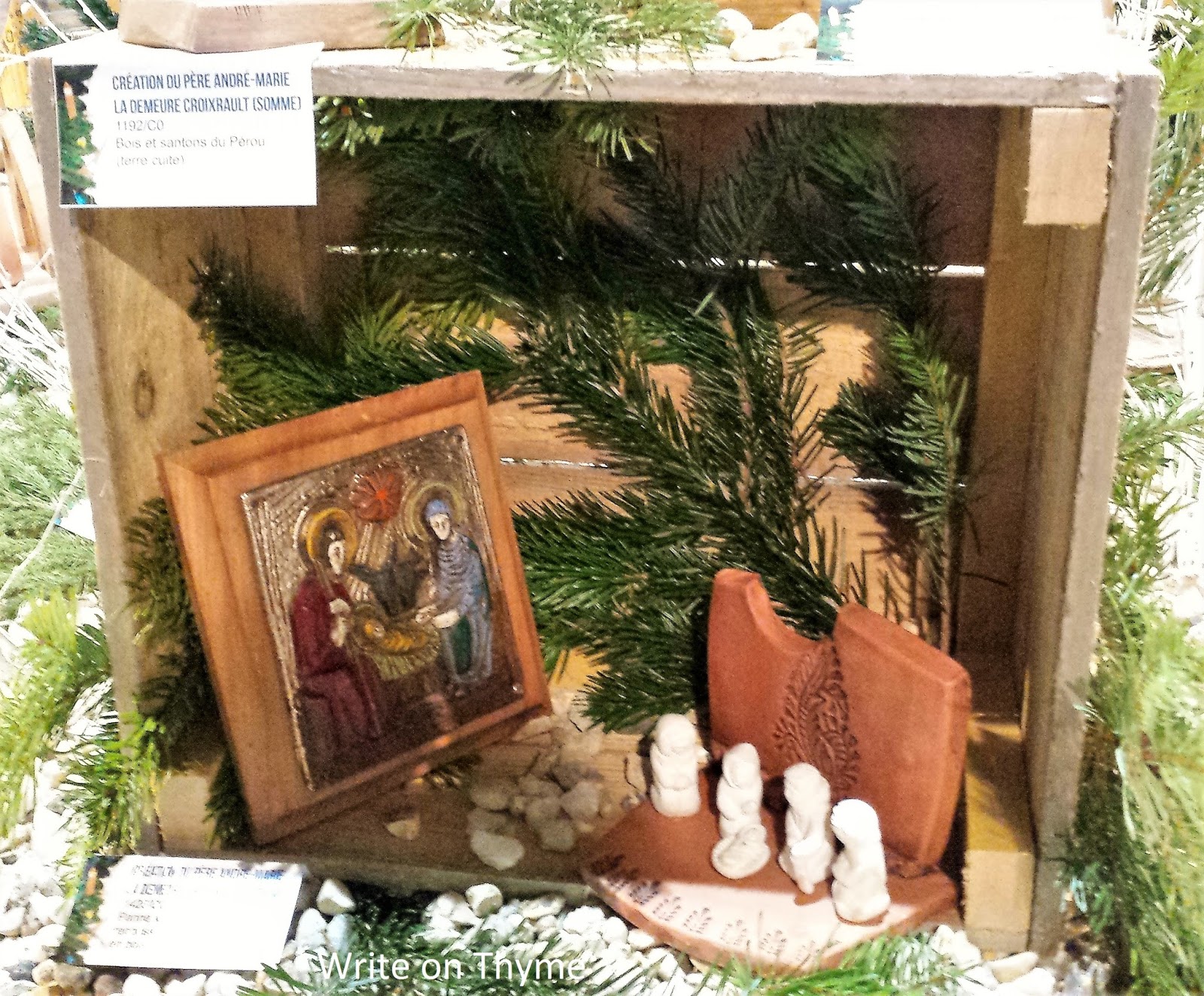
one spot in the church housed several nativity scenes
created by different artists. 


Most of the time,
the nativity scenes do not include the baby Jesus
until Christmas Eve.
He is most often conspicuously missing.


But several of these included him. 


Outside, we walked the streets where I
sometimes can't help but take photos of window displays...
such as these Santas and Christmas items made out of chocolate. 


And this chocolate fountain! 


Most cathedrals in any French town or village
include a monument to the dead soldiers 
of WWI.


And below, the French flag 
and names of the "Soldats morts pour la France."


An exceptional building.


The city of Chalons-en-Champagne
is filled with medieval houses
like the one below. 


Next time I'll share some photos of the church in Paris
where we enjoyed a piano and accordion concert.
Thanks for stopping by! 
And unbelievably,
nearly time to say Welcome to February.


(Photographs copyright: Kirsten Steen)
(Info via Wiki)


Saturday, December 31, 2016

Our 25th Anniversary at Reims Cathedral


We are in Paris for the holidays 
and this past week the Chef and I celebrated 25 years together
with a trip to the French countryside and Reims (pronounced Rance) Cathedral,
lunch on the square
and a complimentary glass of champagne. 


Our first date 25 years ago
involved Champagne Cocktails. 
And this week, as we stood a couple of blocks from the square in Reims
perusing menus in restaurant windows, wondering where to have lunch
before touring the church on our anniversary,
a man walked up, handed us a brochure and told us
if we took it to a certain restaurant on the square 
and showed them the picture, we would be treated to a glass of champagne. 
Not having found anything else we were interested in,
we wandered over to the restaurant and had the perfect lunch,
at the perfect place, right on the square
... with champagne. 


Angels were smiling on us.
And if you look closely, you'll see that
 the very first figure to the right of these doors 
looks like it could be one of the Smiling Angels of Reims. 


Below is a picture of the famous Smiling Angel
on a votive holder.


The cathedral was built in the 1200's
over the site of an earlier church
where Clovis (the first king of the Franks)
 was baptized in 496 A.D
(the original being built about 400.)


It is the church where the Kings of France were crowned. 
Like Chartres, a labyrinth was built into the floor
but here it was later destroyed. 


In its number of statue-laden portals,
Reims is second only to Chartres.


In 2011, the cathedral celebrated its 800th anniversary
with the installation of 6 new stained glass windows
by German artist Imi Knoebel
and nearly 6 months of celebrations
including light shows, concerts, performances, exhibitions.

Click HERE for a Guardian article
 (his first newspaper interview ever given)
with Imi Knoebel (a man of 700 colors) 
and a photo of the actual windows.


During the first world war, 
it served as a hospital
and many of its stained glass windows 
were sadly damaged or destroyed. 


With help partly from the Rockefellers,
it was restored and reopened in 1938. 


And above, the gorgeous Marc Chagall windows in the very far end of the cathedral. 

**************************************

Tomorrow starts 2017, ready or not. 
In numerology, 2016 equals a 9
which is an ending year. 
And with all of the loss this year, 
it certainly has been that. 
Loss upon loss upon loss...

And with 2017, I'm wishing you a magnificent one!
A new beginning, a cycle of abundance and joy
giving the future now what we want to reap. 
I wish for you all the miraculous beauty you can hold within your heart.

A vous, Bonne Annee!!
Til next year....


(Photos copyright: Kirsten Steen
Info via Wiki)